+86 13553888868

kikyo@hanbscnc.com
English

Views: 0 Author: Site Editor Publish Time: 2025-08-04 Origin: Site


How to benchmark against the best practices of advanced factories in Europe and Japan
Swiss-type CNC machines are known for precision, speed, and reliability. But as customer demands shift toward small-batch, high-mix production, and as global competition increases, machining performance alone is no longer enough.
The future belongs to shops that combine digital integration, lean thinking, and organizational agility.
In this article, we outline what an ideal digital operating model looks like for a Swiss CNC factory — including a reference process flow, organizational structure, and key enabling technologies — based on best practices from top-tier factories in Europe and Japan.
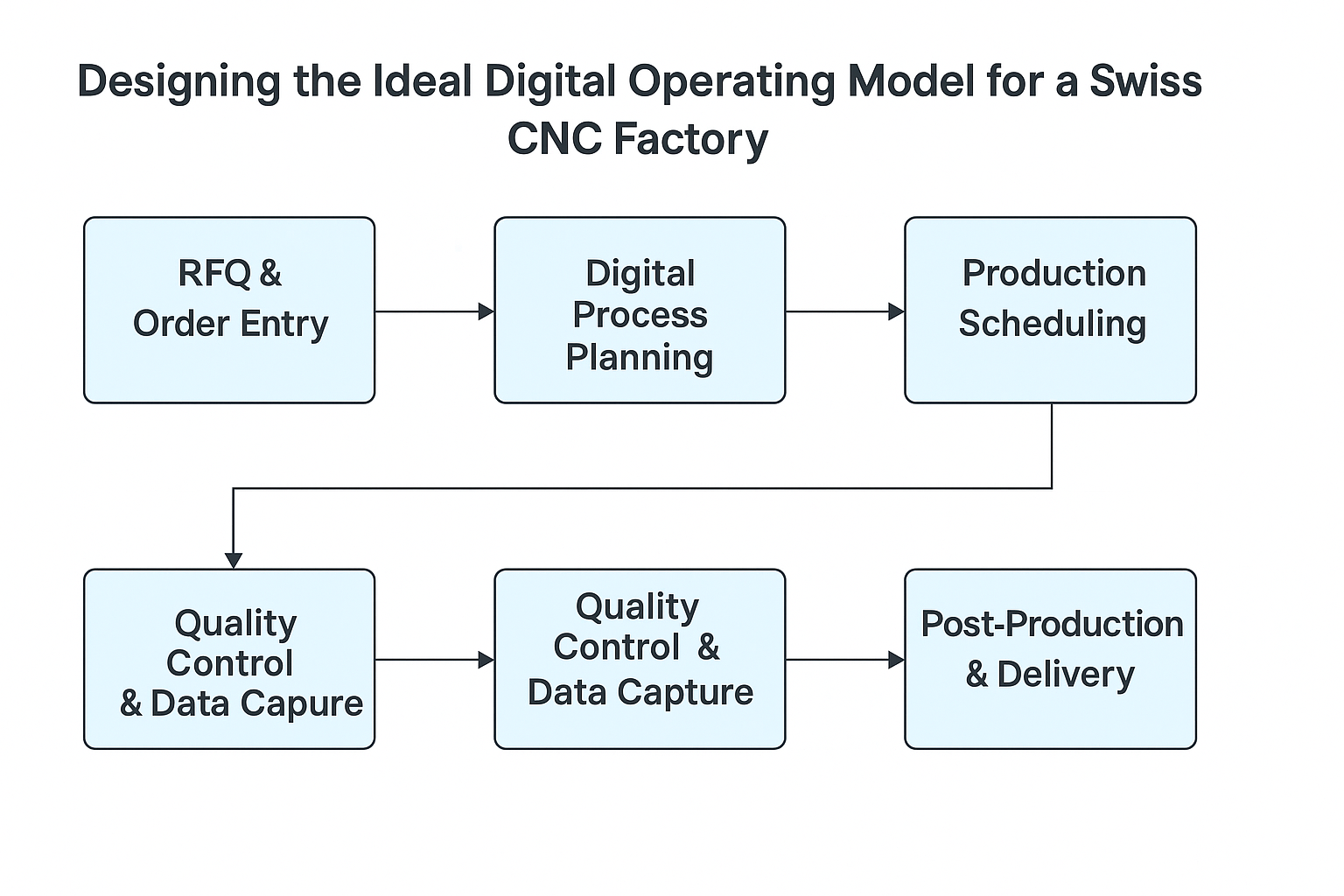
An ideal factory is not just automated — it is intelligently connected. Its core principles include:
End-to-end data visibility: From order intake to part delivery.
Process standardization: Every machine and operator follows controlled, documented workflows.
Real-time decision-making: Enabled by dashboards, sensors, and predictive systems.
Human-machine collaboration: Empowering operators through digital tools, not replacing them.
Here’s how an ideal digitally integrated workflow might look:
1. RFQ & Order Entry (Digital Interface)
→ Quoting software + part database integration
→ BOM and process estimation auto-generated
2. Digital Process Planning
→ CAM programming with tool library & standard templates
→ Setup instructions created automatically
→ Toolpath simulation and cycle time prediction
3.Production Scheduling
→ Dynamic scheduling engine based on capacity, machine type, tool availability
→ Auto rebalancing for rush orders or machine downtime
4.Shopfloor Execution
→ Machine programs downloaded via DNC
→ Real-time monitoring (machine status, OEE, alarms)
→ Operators use tablets for work instructions, SPC, checklists
5.Quality Control & Data Capture
→ In-process inspection data logged automatically
→ Traceability from material batch to final part
→ AI-assisted trend detection and alerts
6.Post-Production & Delivery
→ Automated packing label generation
→ Shipment tracking linked to customer portal
→ Feedback loop for part performance (if applicable)
Instead of siloed departments, the ideal Swiss CNC factory moves toward value stream-oriented teams, such as:
Role | Responsibility |
Cell Lead | Oversees a small cluster of Swiss CNC machines |
Process Engineer | Optimizes cycle time, programming, and tooling |
Digital Coordinator | Maintains MES, dashboards, and automation |
Quality Technician | Handles in-line inspections and traceability |
Planner | Embedded in the team, controls local scheduling |
Each cell or team is accountable for:
Safety
Delivery
Quality
Cost
Improvement initiatives (Kaizen)
Japan (e.g. Citizen, Seiko subcontractors):
Focus on standardized work and visual management
Very low tolerance for waste (lean discipline)
Operators empowered to solve problems on the spot
Europe (e.g. Germany, Switzerland):
High focus on automation + analytics
Modular cells built around machine + robot + CMM
Strong apprenticeship and cross-training systems
What both have in common:
Systems thinking, not just equipment buying
Clear production metrics visible to everyone
Investment in upskilling and culture, not just hardware
To realize the above model, the factory must integrate:
MES / MOM Systems
→ Real-time tracking of machines, jobs, inventory
ERP Integration
→ Seamless quote-to-invoice process
Machine Monitoring / IIoT Sensors
→ Uptime, cycle time, alarm history
Digital SOPs & Andon Systems
→ Visual, interactive work instructions
Smart Tool Management
→ Life tracking, presetting data, auto reordering
Automated Quality Data Collection
→ Through CMM, vision systems, and SPC platforms
If you’re a Swiss CNC shop starting from scratch, here’s a phased roadmap:
Phase | Goal |
Phase 1 | Map current processes; identify digital bottlenecks |
Phase 2 | Digitize work instructions and monitoring (pilot cell) |
Phase 3 | Integrate scheduling, CAM libraries, and tool management |
Phase 4 | Restructure teams into cross-functional cells |
Phase 5 | Add predictive analytics, feedback systems, customer portals |
In the next 5–10 years, the best Swiss CNC shops won’t just machine parts — they’ll orchestrate workflows, data, and people as a fully connected ecosystem.
By adopting a digital operating model inspired by Europe and Japan’s most advanced practices, small and medium-sized manufacturers can stay competitive, efficient, and resilient — no matter how the industry evolves.
✅ Want to go deeper? We can provide templates for process maps, KPI dashboards, and team structures customized to your Swiss CNC environment.